The Symptom You Have Been Googling at Midnight Instead of Talking to a Gynecologist About — and Why That Needs to Change
It happens millions of times every day across India. A woman notices something about her body that concerns her — an irregular period, a discharge that seems different, pain she cannot quite account for, bleeding that does not fit the usual pattern. She does not immediately call a doctor. She opens a search engine. She reads. She reads more. She either partially reassures herself or partially frightens herself, or both simultaneously, and she closes the browser without a clear answer or a clear plan.
This cycle — symptom, search, partial information, deferred action — is one of the most consequential patterns in women's health in urban India. It is not caused by lack of access to information. If anything, there is too much information, of too variable quality, too easily accessed, and too easily misapplied to a specific individual's situation by someone without medical training. What it is caused by is a combination of factors that any honest observer of Indian women's healthcare would recognise immediately: the discomfort of discussing intimate symptoms, the assumption that minor gynecological symptoms are normal or will resolve without intervention, the practical friction of finding and accessing a trustworthy gynecologist nearby, and sometimes a lingering cultural reluctance to prioritise one's own health over the competing demands of work, family, and household.
The result of this cycle, played out over months and years, is that women arrive at gynecology consultations with conditions that have been present far longer than they needed to be — and that have had time to become more established, more symptomatic, and in some cases more complicated than they would have been with earlier evaluation.
The self-medication trap — why it delays rather than resolves. The most common response to recurring gynecological symptoms among women in urban Bhubaneswar is not a doctor's visit. It is a pharmacy visit. Antifungal creams for discharge that recurs every few months. Painkillers taken in increasing doses for menstrual cramps that have been present for years. Iron supplements purchased without investigation of why the periods are heavy enough to cause anaemia in the first place. These responses address the immediate discomfort. They do not address the underlying condition that is generating it.
Recurrent vaginal infections that are treated repeatedly with over-the-counter antifungals without a proper diagnosis may not be fungal infections at all — they may be bacterial vaginosis, or a sexually transmitted infection, or a combination of factors that requires a different treatment entirely. Treating the wrong condition not only fails to resolve it but allows the correct diagnosis to be delayed by months while symptoms are temporarily suppressed and then return. A gynecologist who cultures the discharge, examines the clinical picture, and considers the full history will recommend the right treatment in one consultation — something no amount of pharmacy-guided self-management can replicate.
The same logic applies to painful periods that are managed with increasing doses of anti-inflammatory medication without ever asking why they are painful. Moderate period pain is common and often responds to standard analgesics. Severe pain that requires prescription-strength medication to manage, that interferes with work or normal daily function, or that has been progressively worsening over time is a symptom that warrants investigation — not because it is necessarily serious, but because its cause determines whether it should be treated differently, whether it might affect fertility in ways the woman does not yet know, and whether there is an underlying condition such as endometriosis that has a better outcome with earlier management than later.
The discharge question — what women most commonly do not ask a doctor about. Vaginal discharge is probably the gynecological symptom most frequently managed without professional evaluation in India, and it is the one most likely to be mismanaged as a result. Normal discharge varies throughout the menstrual cycle and is clear to white, odourless or mildly scented, and not associated with itching, burning, or discomfort. Changes from this baseline — a yellow or green colour, a strongly unpleasant odour, a thick cottage-cheese consistency, a grey or watery appearance, or any discharge accompanied by vulval itching, burning, pelvic pain, or urinary symptoms — indicate a condition that warrants proper diagnosis.
The most common causes include candidal infection, bacterial vaginosis, and trichomoniasis — three conditions with overlapping symptoms but different treatments. Candidal infections respond to antifungal treatment. Bacterial vaginosis requires antibiotics. Trichomoniasis is a sexually transmitted infection that requires treatment of both partners. Attempting to treat any of these with the wrong medication produces temporary improvement at best and a delayed correct diagnosis at worst. A gynecologist who takes a swab and examines it, or sends it for culture if needed, provides an accurate diagnosis in a single visit.
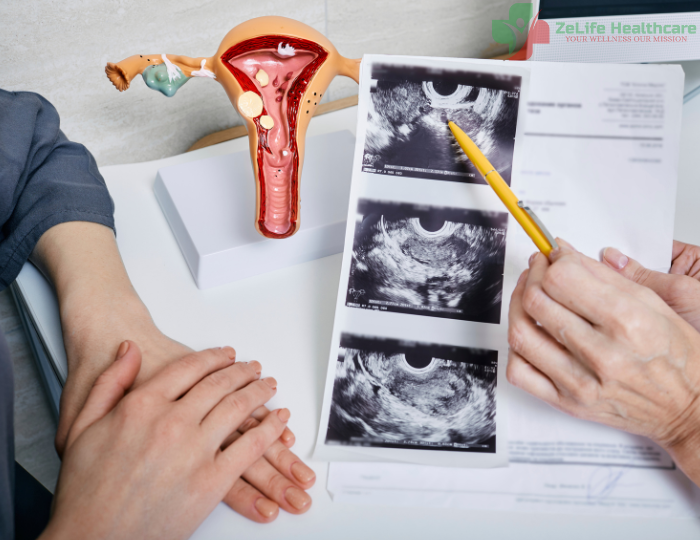
Ovarian cysts — the finding that creates disproportionate anxiety. Ovarian cysts are one of the most common findings reported on abdominal or pelvic ultrasounds in women of reproductive age, and they are one of the findings that generate the most anxiety when communicated without adequate context. The vast majority of ovarian cysts found in women of reproductive age are functional — they are a normal consequence of ovulation, they contain fluid rather than solid tissue, they are typically smaller than five centimetres, and they resolve spontaneously within one to three menstrual cycles without any treatment. A woman who receives an ultrasound report noting a simple ovarian cyst and then searches the internet for what this means will encounter a range of information that is technically accurate in isolation but completely uncontextualised for her specific situation — including information about ovarian cancer that is statistically irrelevant to a healthy premenopausal woman with a small simple cyst but that generates fear that no amount of subsequent reading will fully resolve.
A gynecologist can review the ultrasound report, assess the cyst's characteristics, correlate them with the clinical examination and menstrual history, and explain clearly whether the cyst needs follow-up imaging, no further action, or evaluation for the minority of cases where further assessment is appropriate. This takes one appointment. The clarity it provides is worth more than any number of internet searches.
The pregnancy planning conversation that does not happen soon enough. A significant proportion of women in Damana and surrounding areas are in the phase of life where pregnancy is being considered or actively planned — and a substantial proportion of them approach this phase without a preconception consultation with a gynecologist. This is a missed opportunity that has real consequences. A preconception consultation is the moment to establish whether thyroid function is optimal — thyroid disorders affect both fertility and fetal development and are extremely prevalent among Indian women. It is the moment to review folic acid supplementation, which is protective against neural tube defects and should ideally be started before conception rather than after a pregnancy is confirmed. It is the moment to review vaccination history, including for rubella, which can cause severe fetal abnormalities if the mother contracts it in early pregnancy and which is preventable with a single vaccine dose if immunity is not already established. And it is the moment to identify any medical conditions that might affect pregnancy and that would benefit from optimisation before conception rather than management after it.
ZeLife Healthcare in Damana, Chandrasekharpur provides comprehensive gynecology and obstetrics services with Dr. Kumudini Chaulia and Dr. Monalisa Pal — two experienced specialists whose consultations span the full range of women's health from adolescent menstrual concerns through pregnancy care, PCOS management, fertility evaluation, and menopause support. The clinic operates daily from 7 AM to 10 PM — hours that make a consultation genuinely feasible for working women in Damana, Patia, Niladri Vihar, Sailashree Vihar, Rail Vihar, Kanan Vihar, KIIT, Infocity, and surrounding areas — with in-house pathology, ultrasound, and diagnostic support available for investigations recommended during the consultation.
For every woman who has been managing a gynecological symptom through internet searches, pharmacy visits, or quiet endurance — the consultation that replaces uncertainty with a proper diagnosis and a clear management plan is always available and almost always simpler than anticipated.
👉 Book a consultation or read more here: Gynecologist in Damana, Bhubaneswar — ZeLife Healthcare


Comments
Post a Comment